
|
Today, more and more people are realizing that the effects of modern consumption patterns and poor development practices increasingly cause serious and often irreversible problems to our natural and social environments. With the publication of What Have We Done? The Foundation for Global Sustainability's State of the Bioregion Report for the Upper Tennessee Valley and the Southern Appalachian Mountains, this point was made clear. However as identified by the State of the Bioregion Program Committee, more is known about the negative effects of non-sustainable practices than of the potential which ecological, or sustainable, living practices can offer in terms of community health and environmental welfare.
It has been put forth by many that environmental damage and social problems are interrelated. In many cases these problems are attributing to the loss of self-sustaining systems and community values. Especially in regions such as the Southern Appalachians, where the cultural heritage has traditionally supported these concepts, it is disheartening to see how the current increase of individuality deprive people of the self-reliance in which they have long taken pride. As a consequence, an area formerly and still potentially rich in resources now does not feed itself anymore, importing more than three quarters of its food from outside the bioregion, while industrial jobs fall prey to pressures from international competitive pressures.
In 1995 FGS recognized the need to balance its mostly reactive arrangement of programs and projects with a new program solely dedicated to highlighting proactive solutions to unsustainable living patterns. Behavioral research (see for example Fishbein & Ajzen, 1988) suggests that changing people's behavior can be achieved by changing people's intentions. The formation of such intentions is influenced by three separate components: a perceived social norm, "what do others do?"; an attitude, "what do I know about the environmental crisis, what is my opinion about it"; and a so called "self-efficacy" , "is it possible for me to do something about it?". Each of these three components influences and supports individual choices.
Many researchers have pointed out that people generally do support environmental causes (the attitudinal component). However, a resulting change in behavior is many times not observed: knowing what is wrong with the environment does not automatically imply change in behavior. What people need to know is how they could care for the environment themselves, in the reality of their daily life. What alternatives are there for me? How can I live in an environmental friendly manner?
The goal of the SLP is to empower people to regain control of their lives. Emphasis is placed on living through example and making the "tools" of sustainable living accessible to ordinary people. In this way the SLP helps groups and individuals to attack the root causes of poverty through redistribution of power and resources.
The 5 building blocks
The SLP aims to develop a series of modular programs that reach people at different levels of personal and environmental awareness. The modular programs will form the building blocks of a sustainable living framework. Each of the programs building blocks will have a component value of sustainable living by itself or greater value when combined with building blocks from the other program focus areas. People will be encouraged to explore all the program areas, but will be able to move at their own speed toward a comprehensive shift in lifestyle.
Several building blocks of personal living have been identified and are listed below. Click on these themes for additonal WWW resources.
The SLP researches each of these areas to identify sustainable principles and techniques. The program further attempt to locate organizations and individuals within our region demonstrating these principles and techniques in each program area. The SLP will, if possible, help highlight and replicate these examples. If existing examples cannot be found or do not lend themselves to demonstration or replication, SLP will seek to develop regional demonstration projects that can be replicated.
A. Gardeners Cooperative
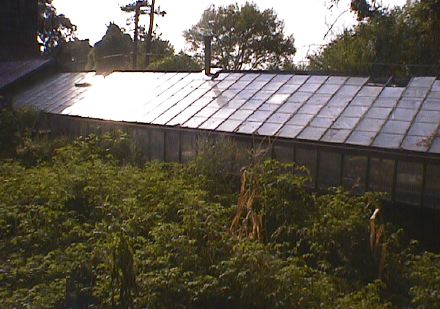
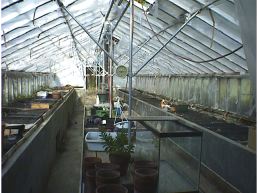
FGS is housed at the Center for Global Sustainability located on Howells Nursery. Howells Nursery is the oldest Nursery in Knoxville (1786) and located at 2743 Wimpole Ave in an East Knoxville low income African-American inner city neighborhood. The sustainable living program has worked with a cooperative Greenhouse Project in 1995 and 1996. +/- 10 active gardeners volunteered in maintenance and used the facilities to grow vegetables, etc.
The goals of the current Gardeners Cooperative are:
1) Initiate a Community Gardening program
Targeted are residents in the surrounding dominantly African-American community. Free seeds are available for subsidized houses through the Green Thumb Project, administered by the Community Action Coalition.
2) Develop an urban agriculture education facility.
Goal would be to give workshops and lectures about organic gardening and permaculture principles.
3) In the long term strive to find funds and means to support agricultural research on:
Organic agriculture,
Permaculture,
Biodynamic farming,
Community agriculture,
The following facilities are present and at our disposal at the Center:terraced gardens
greenhouse with adjacent workspace
gardening and maintenance tools
composting bins
large conference room
parking space
several models for sustainable living, such as solar panels, rainwater catchment systems, etc.
library on sustainable technologies (incl. permaculture)
B. Introducing Sustainable Living
The principles and ideas behind sustainable living are unknown to many in our society. To introduce these principles the following methods, based on the 5 building blocks (food, shelter, transportation, health and energy), will be used:
1. Educational materials
Easy accessible informational brochures, or flyers can be distributed in public places. The aim would be to provide people with educational materials as well as helpful tips and places to go. Funding for the printing costs of the brochures could be provided through small adds. The eventual goal would be to integrate the 5 building blocks in an easy accessible Citizens Guide to Sustainable Living. The brochures, as well as the guide, will also be made public on the internet.
2. Workshops, excursions, presentations
3. Annual Tour of Solar Homes
C. Supporting EcoVillage development initiatives
The SLP has set the long-range goal of researching and eventually establishing the design of a series of self-sustaining ecological living environments, known as "Ecovillages." According to Robert Gilman of the Context Institute, an ecovillage is:
a human scale, full featured settlement which harmlessly integrates human activities into the natural world in a way that is supportive of healthy human development, and can be successfully continued into the indefinite future.
Ecovillages deliberately pay attention to and manipulate the relationships between the physical/ecological design of our living environment and the way this affects our social behavior. Exemplifying this relationship, the worldwide ecovillage movement --concerning both urban and rural design-- is slowly developing. Ecovillages represent a "leading edge" in the movement toward developing sustainable and just human settlements and provide a testing ground for new ideas, techniques, and technologies which can then be integrated into the mainstream. Participatory in nature, ecovillages are based upon a shared community ethic and cooperation.
Supporting EcoVillage initiatives, the SLP program participates in an initiative that aims to serve as a large scale model for local sustainable community design and living: The Knoxville Ecovillage Project. Although in its organizational infancy, the goal of this project is challenging and fascinating: to design and create an ecological living environment, within the Knoxville inner city area, that can serve as an educational center for residents, Knoxvillians and visitors. At this time, few examples of such urban neighborhoods exist in the United States, which makes the project not only exciting and challenging, but also a valuable addition to Knoxville's ecological community.
Goals: To aid in the reversal of the negative environmental, social and economic impacts of unsustainable growth and developmentTo foster appreciation for and participation in the equitable distribution of resources across race, gender, socio-economic status, and time horizons (generations)To contribute to the conservation of traditional Appalachian values of self-reliance and self-determination through generation of knowledge and self confidence
Objectives: Educate different social groups, communities and individuals about sustainable living and the ecovillage conceptProvide the methods and techniques needed to develop sustainable lifestyles through access to information and demonstration projects
Strategies: Develop a Gardeners Cooperative, functioning as a basis for community gardening, urban agriculture, and research on Organic and Biodynamic farming, Permaculture and Community Agriculture.Conduct integrative research on sustainable living practices and Ecovillage development in the Southern Appalachian region, contributing to the existing knowledge baseIntroduce the principles behind sustainable living through through modular building blocks (food, transportation, energy, shelter and health).
1) the creation an easily readable and informative Citizens Guide to Sustainable Living,
2) conduct workshops, organize excursions and hold presentations on sustainable living.
3) Organize an Annual Tour of Solar Homes
Support initiatives which promote Ecovillage development in the Southern Appalachian region, such as the creation of the The Knoxville Ecovillage Project
Click here for information about Narrow Ridge, a sustainable living community right here in East Tennessee.
Click here to read Sustainable Living: The Rise of the Ecovillage Movement in America, written by Karen Lacey, FGS Intern from the Department of Sociology, University of Tennessee
Revisit the 1997 National Tour of Solar Homes, Sponsored by the American Solar Energy Society
Revisit the 1997 Strawbale Workshop held in cooperation with Howard Switzer, Architect, and Ijams Nature Center
Click here to access the Sustainable Energy Guide: International Resources for Energy Efficiency and Renewable Energy.
Read the latest from Homepower Magazine.
